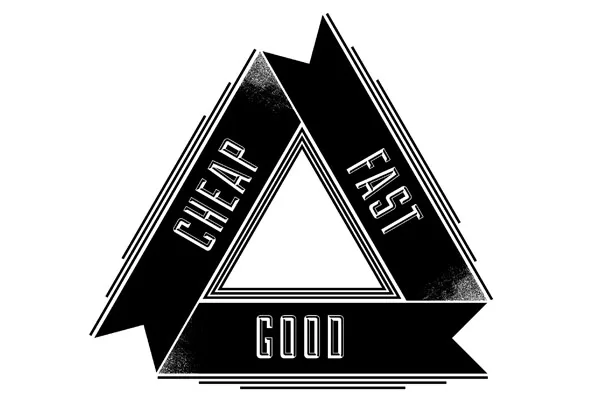
A good mantra to follow when discussing projects with clients is to offer three three types of service. Fast, Cheap, & Good.
I came across this phrase while listening to a webinar the other day and have subsequently created this print (which is now up in my studio as quiet reminder). It’s a fairly basic principle where all clients have access to three services, but can only pick two of them.
Apparently a Dr. Martin Barnes created this “project management” triangle and the phrase fast cheap good back in the 1970s.
I think it’s a fair and realistic principle in any project-related undertaking. And something that illustrators, designers and clients, should bare in mind.
Fast + Good = Expensive
This is a “drop everything” scenario, burning the midnight oil and working after hours to deliver your work to a high standard with the tightest of deadlines.
Good + Cheap = Slow
Most cases, work needs to be done ASAP but if you are constrained by budget, perhaps you can save money by planning ahead? With a longer timeframe, more thought and options can be given to a brief that might not have a need it now budget.
Fast + Cheap = Quality Suffers
As the rule says, you can’t have it all. If you don’t want to pay for first class seats, you shouldn’t be surprised if the hostess politely moves you back to economy. Something has to give, and a rushed, cheap job is the worse scenario out of the three.
Read more about the Project Triangle
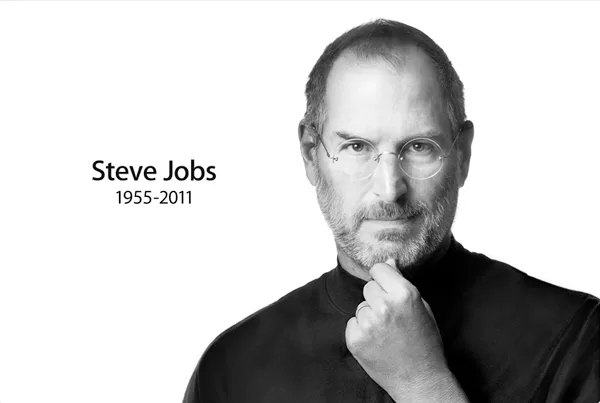
Steve Jobs was a torch bearer for design. By making product that just worked for me meant Mac became my tool in illustration.
In the mid ’90s, the computer room in my university was a foreign place for a fashion designer. Most of our hours were spent slaving away at the pattern cutting table, queuing for our go on the steamer, or behind an industrial sewing machine that could probably power a small car. The contrast between the two rooms couldn’t be more clear; technological vs industrial.
However both were perhaps the most inspirational rooms I have worked in. A fashion degree is an expensive thing and sadly my budget would not extend to actually owning a computer until quite sometime after I graduated. Sure, growing up at home we enjoyed incarnations of the Spectrum, my mum had shown me email at her work, I saw the beginning of Cuebase’s music production on a friend’s Atari ST.
I could see their potential, however I felt restricted by the clunkiness and crashes of it all, my imagination wanted to be able to do so much more with these buttons and monitors.
Some time in the later half of the ’80s I had been amazed by the animated short Luxo Jr. from the then little known company called Pixar. I was frustrated at the disparity between those images that could be produced professionally, and the fact that I couldn’t just drive off the track and visit the mountains on the horizon while playing Pole Position. At this stage, this was no tool to help visualise my imagination.
That was until I got into the computer room at University. A room full of Apple Macs.
Illustration was always a big part of my degree. I’d seen how this could be enhanced by marrying it with computer graphics. Jason Brookes was the star in ascendance with his highly styled, vector art, arguably one of the first and thus often mimicked. I immersed myself amongst the graphic designers and picked up my first skills in illustrator and Photoshop (while at the same time taking my first surf on the internet).
All at around the same time Jobs had returned to Apple.
Graduating left me in office work to repay my urgent debts. A world of spreadsheets, of grey, of rules, boundaries and limitations and a world of PCs. I left without another job to go to and sat in my girlfriend’s bedroom on her power mac brushing up my portfolio. Within a month, I was designing product for DuFFS a Californian skate brand. Shortly after, I got a G4 into the office, the staff got iPods for Christmas to reward our hard work. At the same time even one of the directors picked up a macbook. I now Skype my mum & sister who have both been Apple converts.
There is something eternally optimistic about the start up noise every Apple makes – typing on its keyboard feels better, its programes integrate seemlessly, laptops in aluminum (not plastic) feel more luxurious. This is what design is about – using something should be a pleasure not a chore. I am no computer expert so when your equipment is focused on user-friendly design, it makes it easier for you to concentrate on the task you set out to do. And as someone has researched, experimented, innovated and improved every inch, every pixel, every chip within the machine that I am writing this on right now. We don’t have to figure out why or how it works, it just does.
Quite marvelously, Apple seem to avoid the dreaded design by committee. Compromise is so rarely evident in their product although I do have to wonder how well supported Jonathan Ives design arguments will now be without Jobs at the helm.
“In most people’s vocabularies, design means veneer. It’s interior decorating. It’s the fabric of the curtains and the sofa. But to me, nothing could be further from the meaning of design. Design is the fundamental soul of a man-made creation that ends up expressing itself in successive outer layers of the product or service.” Steve Jobs in an Interview with Fortune Magazine, 2000.
With his departure, I can’t but help think that product design has lost one of its greatest bastions. But on the other hand, perhaps he has brought great design to the masses and created a model that can be upheld and (as he would expect) excelled in the future.
Photo courtesy of Apple Inc.